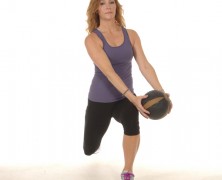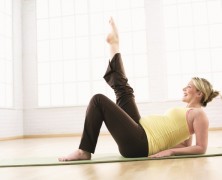
A well-designed fitness program should incorporate multiple types of training, including cardio, strength, flexibility, balance, and agility. By focusing on multiple aspects of fitness, you can boost your level of health and fitness, reduce the likelihood of injury, and keep your level of motivation high. Jim Borden, a personal trainer with Fitness Together, a gym located in Newtown Square, Pennsylvania, takes a look at each area:Cardio – Cardiovascular exercise, also known as aerobic exercise, is any type of activity that increases the work of the heart and lungs. Walking, running, bike riding, and swimming are all examples of this type of exercise. According to the Physical Activity Guidelines issued by the American College of Sports Medicine (ACSM) and the American Heart Association (AHA), adults should get at least 30 minutes of moderately intense cardio (similar to a brisk walk), five days a week, or vigorously intense cardio (rapid breathing and an increase in heart rate) 20 minutes a day, three days a week.Strength – Strength training, also known as resistance training, are any activities designed to strengthen your muscles. Resistance can come in many forms – weights, resistance bands and tubing, even cans of soup. The ACSM and AHA guidelines for strength training recommend a minimum of two days per week (nonconsecutive), incorporating 8 to 10 exercises that involve all major muscle groups. Each exercise should include resistance that allows you to do the exercise for 8 to 12 repetitions.Flexibility – Often referred to as stretching, flexibility is often an overlooked part of many fitness programs. Flexibility could also include activities such as Tai Chi, yoga, or Pilates. There are two basic types of stretching – dynamic and static. Static stretching is when you take a muscle to the point of tension and hold it there for a minimum of 20 seconds. Dynamic stretching involves moving a joint through its full range of available motion.Balance – Balance activities could include exercising while standing on one leg, and using a stability ball or a BOSU ball. Even when not exercising, you can work on your balance by standing on one leg and keeping your eyes closed or simply sitting on a stability ball at your desk. Balance exercises can be incorporated into your normal exercise routine or done separately.Agility – Agility refers to the ability to start, stop, and change direction quickly, while maintaining proper balance. Research has shown that agility training can reduce falls in the elderly by almost 50%. Examples of agility exercises include hopping in multiple directions, having a catch while on a BOSU ball, or kicking a soccer ball back and forth. Agility drills can be easily incorporated into your exercise routine, and are a nice way to add some variety into your workouts.As you can see, there is more than just cardio and strength training in a well-designed fitness program. Before you start on such a program, be sure you have your doctor’s approval. And if you are not sure how to begin, it is worth using a personal trainer to ensure you are using proper form and are aware of the safety precautions necessary when working out. The information in the article is not intended to substitute for the medical expertise and advice of your healthcare provider. We encourage you to discuss any decisions about treatment or care with an appropriate healthcare provider.
gas monitors
Good balance isn’t just for surfers and skiers. As an MMA fighter, you need good balance to prevent injury, build strength, and control your opponent. Ask your average fitness professional how to train for balance, and he or she will probably recommend you hop aboard a wobble board, balance ball trainer or the like — all unstable-surface training (UST) devices.
But recent research suggests that the practical applications for UST are more limited than wobble-boarders would have us believe. Doing UST can actually de-power healthy MMA athletes because it’s not functional. (In its truest sense, functional training prepares individuals for the demands of work, daily life and competitive athletics.) The floor of a typical MMA ring or cage doesn’t move so, unless you’re preparing to surf, skateboard or snowboard, wobble exercises may detract from your goal: performing well on solid ground.
MMA Supplements
MMA Nutrition
Stable Surface vs. Instability Recent studies put a group of athletes on a standard stable-surface training program and another group on an unstable-surface program. This research showed that replacing as little as 2 to 3 percent of overall training with unstable-surface training in healthy, trained athletes impaired the development of sprinting speed and vertical jump height.
Why the drop in power? It could be because UST causes you to pronate more quickly and for longer periods of time than does stable ground, putting you constantly in “deceleration mode.” Over time, this could limit how well you can store and release elastic energy in lower-body muscles during running and jumping. Or, UST might simply train you to react tentatively, even when an explosive movement is required.
While the specific reasons UST interferes with power improvements warrant further investigation; our training needs to reflect the demands of our sports. We can’t train slowly on an unstable surface and expect to be fast and powerful on a stable surface. The study that trained on stable surfaces showed significant gains in power tests such as the vertical jump and sprinting speed. It’s no leap of logic, then, to presume it’s beneficial to use that kind of surface during training if we want to jump higher and run faster. Or for MMA: hit hard, sprawl faster, kick higher, or shoot with more speed.
So what can you do to improve your balance? Simply put, you need to challenge your stability while your lower body remains in contact with solid ground. This includes training techniques ranging from single-leg work and asymmetrical loading to applying destabilizing forces while attempting to remain stable.
Train on One Leg. You can incorporate unilateral (single-leg) training into what, for most of us, is a bilateral training world. In other words, keep one foot planted firmly on the ground. Besides strengthening the small stabilizing muscles around your spine, unilateral training helps you build strength equally in both legs (it doesn’t allow for unhealthy compensation patterns the way bilateral training does), strengthening any weak points in the chain. You’ll also reinforce knee-stabilizing muscles, thus preventing knee injury.
Alter Gravity. You can also improve your balance by moving your center of gravity upward or forward. The higher your center of gravity, the less stable you are, which forces those core and intrinsic spinal muscles to work harder to compensate. An object with a lower center of gravity is more stable because more work is required to topple it. To challenge yourself, raise your center of gravity by performing moves with one or both arms above your head or in front of you, he suggests. You challenge yourself more by standing with both feet planted, bringing a barbell to chest level and then raising it overhead. The higher you go, the tougher it is to stabilize.
Close Your Eyes. Closing your eyes during certain exercises can improve your proprioception, which in turn can help prevent injury by increasing your agility and reaction times. By shutting off your sense of sight, you force your neuromuscular system to do all the reacting. Closing your eyes works best when you’re performing the most basic of exercises. Start by closing one eye while you stand still with both feet on the ground, then progress to standing with both eyes closed, standing on one foot with one eye closed, and finally standing on one foot with both eyes closed.
When Is Unstable-Surface Training a Good Idea? There are times when unstable-surface training (UST) is not only helpful, but necessary. Lower-body UST has a ton of merit in those returning from ankle sprains. UST has proven effective time and again when addressing the chronic functional ankle instability found with sprains. This is because UST helps to retrain the peroneals — the muscles on the outsides of your lower legs — to react quickly and prevent future sprains.
UST is great for training your upper body, too. While in sport and life, the lower body is in contact with a stable surface most of the time; the torso and arms are constantly engaged in motion without being anchored to the floor. So it’s appropriate to work the upper body and torso by making them unstable, as long as your feet are solidly planted on the ground. If it’s at or above the hips, you’re in good shape. So, go ahead and do pushups on a BOSU or dumbbell presses using a stability ball as your “bench.”
swarovski crystals


Recent Comments